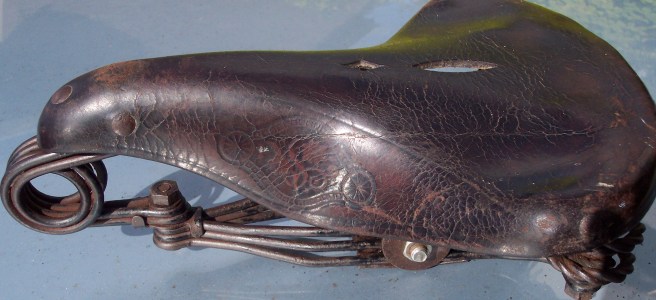
I have acquired a saddle, a bit of summer indulgence. It's something of a mystery piece. In general design it much resembles the classic Brooks B90/3, but it is of smaller make all round - the cover is not so large, the springs, though sturdy, not quite so stout and of smaller circumference. Its proportions … Continue reading Summer Saddle Mystery
Category: MUSINGS ON . . .
occasional effusions on every subject under the sun
A Way of Thinking
Poetry is a way of thinking. By ‘poetry’ I mean not just poetry but everything that works in a similar fashion - by imagination and instinct - such as music and art generally (it’s handy to remember that ‘poetry’ just means ‘making’) - and by ‘thinking’ I mean rather more than the narrow sense in … Continue reading A Way of Thinking
Saddle Strain – a cautionary tale
The aesthetics of saddles are curious: a visit to eBay shows that old saddles (often well past their prime) command a lot of interest - yet in an age where retro sells, the principal maker of leather saddles (Brooks) is only slowly reviving their classic heritage... chestnut brown leather looks so much better than plain … Continue reading Saddle Strain – a cautionary tale
Stories: the Odyssey and Ulysses
Stories are tales of the past recounted in the present. Each of these elements - the past, the recounting, the present - is important to an understanding of how stories work. In storytelling, the important relation is not between the story and its original (a mistake moderns are increasingly prone to make) but between the … Continue reading Stories: the Odyssey and Ulysses
But is it REAL? Is Art a Joke? – Five Funny Things
I have been thinking about abstraction recently, particularly the relation of what is abstracted to what it has been abstracted from, since it seems to me to have a bearing on things that are of interest to me, such as philosophy, metaphor and art. So I was amused to run across a couple of things … Continue reading But is it REAL? Is Art a Joke? – Five Funny Things
Education compared to a Penny-farthing Bicycle
‘A growing body of literature has linked the ability to delay gratification to a host of other positive outcomes, including academic success, physical health, psychological health, and social competence.’ - Wikipedia articleI don’t know about the rest, but I find the link with academic success interesting: I can see why it might be the case, … Continue reading Education compared to a Penny-farthing Bicycle
Why is a raven like a writing desk? The power of abstraction.
Abstraction is an interesting notion. The word itself is derived from the Latin preposition ‘ab’ meaning ‘from’ or ‘away from’ combined with the verb ‘trahere’ ‘to pull or draw’ (which also gives us our word ‘tractor’) - thus it means, literally, ‘to pull or drag away from’ so that it conveys the sense of separation, … Continue reading Why is a raven like a writing desk? The power of abstraction.
An altered landscape
The world is a different place when people you know are gone out of it: it is as if the roads and railways to familiar places had been closed, the towns themselves removed from the map, the landscape changed; the course you took for granted, always assumed would be available to you, is shut off, … Continue reading An altered landscape
A strange and deep-rooted suspicion: why does art make us uncomfortable?
Here is a list of words that all relate to laudable, creative activity - as practised by artists, writers and the like - but what else do they have in common? fabrication fantasy fiction imaginary invention made-up story tale Yes - they can all be used in a pejorative sense, as synonyms for deceit or … Continue reading A strange and deep-rooted suspicion: why does art make us uncomfortable?
Three Misleading Oppositions, Three Useful Axioms
There is an interesting comparison to be made between people and language: we can - especially when we are young and earnest - come to see both as standing in need of improvement, though essentially perfectible (with ourselves as the agents of perfection, naturally); only when we are older do we come to think that … Continue reading Three Misleading Oppositions, Three Useful Axioms