

'Mind-forged manacles', as well as being one of Blake's most resonant phrases, also shows how well (and succinctly) poetry (and art in general) can express a complex idea that it is difficult to express by standard reasoning. At the heart of Blake's phrase is a contradiction, something that is anathema to conventional reason: 'forging' is … Continue reading Force of Habit
Category: language-related
‘Is there light in Gorias?’ – reflections on metaphor and truth
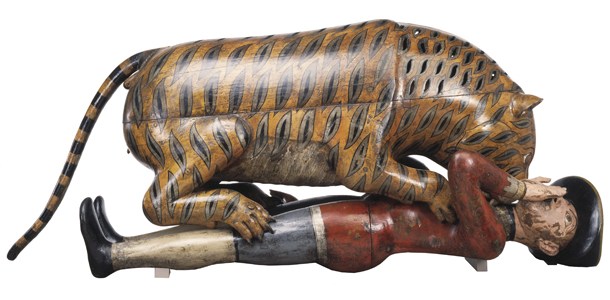
‘Metaphor: a figure of speech by which a thing is spoken of as being that which it only resembles, as when a ferocious person is called a tiger‘ – Chambers Dictionary Saddling metaphor with a definition like that (which is typical, even down to the threadbare example) is akin to giving it a criminal record … Continue reading ‘Is there light in Gorias?’ – reflections on metaphor and truth
Can you be offside in chess?
(The Football Players by Henri Rousseau) Two people are arguing; one insists that you can score a drop goal in football, the other that you can’t. Eventually it emerges that the first is talking about rugby football, gaelic football and Australian rules; but the other means only association football. So who is right? Once we … Continue reading Can you be offside in chess?
Four Myths

(picture: 'la reve' by Henri Rousseau, Museum of Modern Art, NY)I have touched elsewhere on our ambivalence about stories and story-related words, in particular that we use a range of them as synonyms for lying and falsehood. The word ‘myth’ falls into the same category, except that its case is perhaps more extreme: for the majority … Continue reading Four Myths
Head and Heart (1)
A thought about therapy in relation to art and music struck me after listening to James Rhodes in a TV programme, Notes from the Inside, in which he - a classical pianist and former psychiatric patient - takes a grand piano into a psychiatric hospital to play pieces he hopes will resonate with patients: calling … Continue reading Head and Heart (1)
Why is a raven like a writing desk? The power of abstraction.
Abstraction is an interesting notion. The word itself is derived from the Latin preposition ‘ab’ meaning ‘from’ or ‘away from’ combined with the verb ‘trahere’ ‘to pull or draw’ (which also gives us our word ‘tractor’) - thus it means, literally, ‘to pull or drag away from’ so that it conveys the sense of separation, … Continue reading Why is a raven like a writing desk? The power of abstraction.
A strange and deep-rooted suspicion: why does art make us uncomfortable?
Here is a list of words that all relate to laudable, creative activity - as practised by artists, writers and the like - but what else do they have in common? fabrication fantasy fiction imaginary invention made-up story tale Yes - they can all be used in a pejorative sense, as synonyms for deceit or … Continue reading A strange and deep-rooted suspicion: why does art make us uncomfortable?
Three Misleading Oppositions, Three Useful Axioms
There is an interesting comparison to be made between people and language: we can - especially when we are young and earnest - come to see both as standing in need of improvement, though essentially perfectible (with ourselves as the agents of perfection, naturally); only when we are older do we come to think that … Continue reading Three Misleading Oppositions, Three Useful Axioms
The Shadow and the Stone: reflections on the mechanism of metaphor
I mentioned elsewhere that there is a puzzle in our use of metaphor to expand our range of thought: if we think of the unknown in terms of the known concrete, as Vita Sackville-West has it, how does that get us anywhere new? I think I have the answer: it is by a process not … Continue reading The Shadow and the Stone: reflections on the mechanism of metaphor
‘With shabby equipment, always deteriorating…’
We live in an age of infrastructure: we take for granted an underpinning layer of nigh-magical technology, much of it electronic, on which our day-to-day lives rely; occasionally we are visited by anxiety lest it should fail - as the result of a solar storm, perhaps, such as a repeat of the Carrington Event of … Continue reading ‘With shabby equipment, always deteriorating…’
 COMPLEAT TROWZER