

Sawing is not something you readily associate with book-making – sewing, certainly, but taking a saw to a book has a suggestion of destructive violence about it; yet if you are dealing in volume production, sawing is an essential step before sewing can take place.
It is also, I have to confess, one of the elements I never mastered fully – unlike all the rest, it was always a chore, though I think it need not be.
The idea is simple enough – by clamping the unsewn signatures together, spine upward, and sawing across them at several points, you create the holes you will then use for sewing; and because you do them by making a cut across all the signatures at once, you guarantee that they will be aligned, which saves a deal of marking out and individual hole piercing with an awl.
As mentioned already, I had anticipated this stage by printing lines across the spine of each signature to indicate where the cuts should be made. Those worked well enough; the difficulty was all with the saw. I tried several, starting with a neat little model-maker’s tenon saw with a reinforcement to keep it rigid:
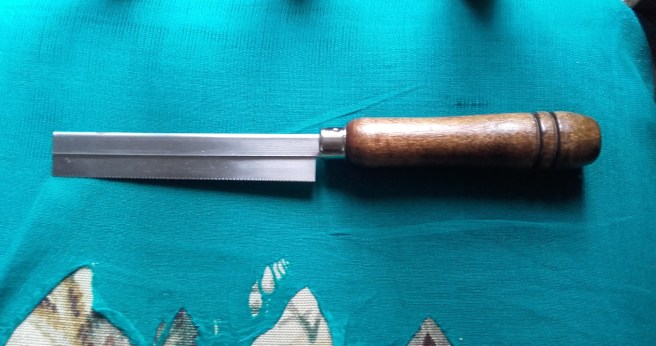
As you can see, the saw is quite fine, and creates lateral slits rather than holes; it also takes longer than you think to penetrate all eight sheets of paper in the signature, so that even after what seems an inordinate amount of sawing, and the growing feeling that you might have inflicted permanent damage, you unclamp it nervously only to discover that you have not actually penetrated the inmost sheet.

I did switch to what was effectively a round file in a jigsaw frame, and this flattered to deceive – it cut satisfactory trenches across the spine, and seemed to have made rapid progress so that you felt sure this was the answer, only to find on unclamping that again you had not sawn deep enough.

I tried both a standard jigsaw blade – quite coarse – and at the other extreme a fine piercing saw (which I used to cut a vee with two cuts, so doubling the labour) and even at one point a full-sized tenon saw, though this really called for a fixed vice (for the rest I simply held the clamp on my knee).

I hit on the idea of sawing several copies at once and made a suitable apparatus but setting it up proved too laborious (the thickness of several copies made it hard to exert an even pressure across all of them and those in the middle tended to sink a bit under the pressure of the saw).
The model-maker’s saw was probably the best overall, but I think I would want one with a thicker and perhaps coarser blade next time, and a better designed-clamp that ensured the signature protruded by precisely the amount you need to saw through. (On reflection, much of the tedium was caused by feeling sure, as you were sawing, that you had certainly gone far enough and possibly too far, only to discover (having undone all the clamping) that you had not gone far enough – so a more precise clamp or press would help)
In the event, I found that imperfectly-formed holes could be corrected fairly speedily at the sewing frame using the needle, though occasionally at the cost of stabbing your fingers, since you went in from the rear but had to take care to emerge at the right point in the middle sheet.
 COMPLEAT TROWZER